That gray curtain hanging over the city isn't just an eyesore—it's a warning. When haze alerts go out, most families do the instinctive thing: shut the windows, close the doors, and stay inside. It feels like the right call. But here's the uncomfortable truth: sealing your home without active filtration can turn it into a pollutant trap, concentrating the very particles you were trying to escape.
Here are five signs your home may already be working against you.
5 Signs You're Living in a Pollutant Trap
1. You notice a persistent musty or stale smell. Stagnant air is a red flag. When air can't circulate or get filtered, dust, mold spores, and volatile organic compounds (VOCs) accumulate. If your sealed room has a lingering odor even after cleaning, the air itself may be the problem.
2. Family members experience more sneezing, coughing, or irritated eyes indoors. If symptoms flare up at home but ease when you step outside, indoor air quality—not outdoor pollution—could be the culprit. PM2.5 particles, which are 30 times smaller than a human hair, are small enough to bypass your body's natural defenses and enter the bloodstream.
3. Dust settles quickly on surfaces after cleaning. Rapid dust buildup signals that particulate matter is cycling through your space with nowhere to go. Standard cleaning redistributes particles back into the air rather than removing them.
4. Your home uses scented candles, sprays, or incense regularly. These add unnecessary particulate matter and VOCs to a sealed space, compounding the problem they're often meant to mask.
5. You haven't changed your air filter—or don't have one—in months. A clogged or absent filter means your home has no active defense against airborne threats, regardless of how tightly sealed it is.
The 4-Step Checklist to Clear the Air
Once you've identified the problem, here's how to start taking back control.
Step 1: Seal strategically. Keep windows and doors closed during peak pollution hours—typically rush hour and midday. But don't stop there. Check for gaps around door frames and window edges where outdoor air can seep in unfiltered.
Step 2: Clean smarter, not harder. Swap your broom for a damp microfiber cloth. Sweeping and dry dusting kick settled pollutants back into the air. Microfiber traps particles and removes them from the surface entirely.
Step 3: Control your humidity. Keep indoor humidity between 40% and 60%. Too dry, and your airways become irritated and vulnerable. Too humid, and you create the perfect environment for mold. A simple hygrometer can help you monitor this.
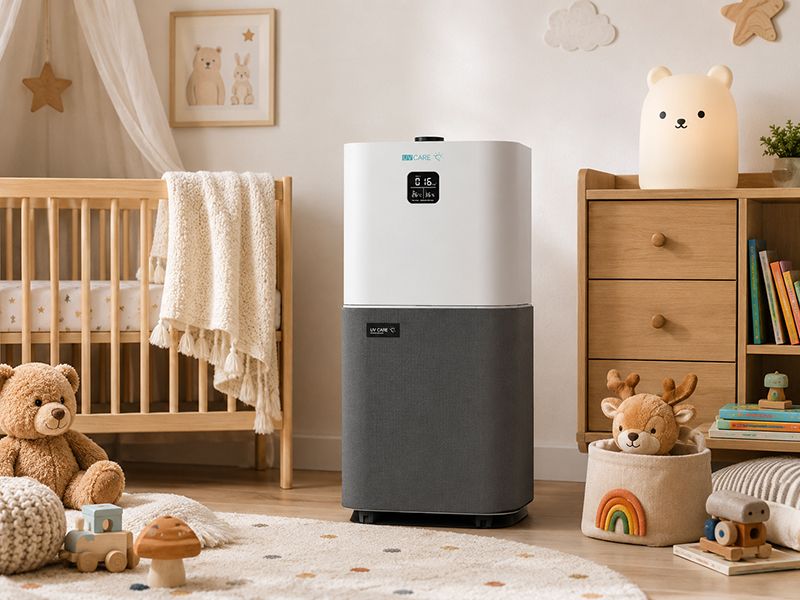
Step 4: Add active filtration. This is where habits alone fall short. No amount of wiping or sealing eliminates PM2.5 already circulating in your space. UV Care Air Purifiers provide medical-grade protection through a multi-layer defense system including a Medical-Grade H13 HEPA Filter that captures 99.97% of microscopic threats, a built-in UVC germicidal light that neutralizes the DNA of viruses and bacteria before air goes back to your space, and patented VIRUX technology that eliminates viruses on contact the moment air passes through.
Breathe Without Compromise
Your home should be a sanctuary, not a sealed chamber full of invisible risks. The good news is that with the right habits and the right tools, you can take direct control of what your family breathes—regardless of what's happening outside your window.
Right now, UV Care Air Purifiers and HEPA Filters are available at 10% off, and for a limited time from June 16-18, room sterilizers are at 10% off in the edamama app! Because a germ-free space isn't a luxury—it's the baseline your family deserves.
